The Long Journey of the Tomato Across Oceans and Kitchens
The long journey of the tomato connects its American origins to new foodways across the Atlantic and beyond, showing how local cooks made it their own.
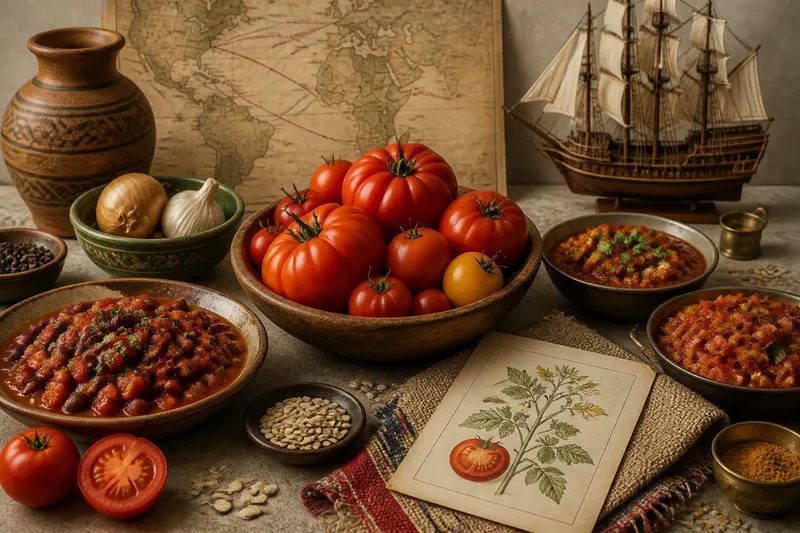
The long journey of the tomato began in the Americas, where Indigenous communities cultivated it long before European ships carried it across the Atlantic. Its later history is not simply a story of a plant reaching new shores: it is also a record of who moved it, how it was received, and how cooks fitted it into established foodways.
How did the tomato travel from the Americas?
Tomatoes were cultivated in Mesoamerica before Spanish forces entered the region in the sixteenth century. The Nahuatl word tomatl entered Spanish as tomate, a reminder that the fruit and its name crossed cultural boundaries together. Spanish colonial routes connected the Americas with Europe and with Manila in the Philippines, a port in the transpacific trade network. The tomato moved through these routes alongside many other plants and goods.
It is difficult to reduce that movement to one voyage or a single moment of introduction. Seeds could be carried by merchants, sailors, officials, and settlers; plants could then be grown, shared, or left aside. The surviving record is uneven, so a careful history distinguishes these known routes and colonial contexts from claims about exactly who first planted a tomato in any particular place.
European botanical writing offers a dated landmark. In 1544, the Italian physician and botanist Pietro Andrea Mattioli described the tomato, then known in Italy as a form of “golden apple,” in a printed herbal. That record shows that the plant was known to European readers by that time; it does not identify the first European to encounter it or the precise route by which it reached Italy.
Why did the tomato find different places in different kitchens?
A plant’s arrival does not automatically make it food. People had to decide whether it belonged in a garden, whether it was safe to eat, and how it might fit into familiar meals. In Europe, early suspicion and curiosity coexisted with cultivation. Over time, regional cooking habits, local agriculture, and changing tastes helped determine where tomatoes became ordinary ingredients.
Colonial networks carried crops, but they also carried unequal power and disrupted existing lives. The tomato’s movement should not be told as a cheerful exchange detached from the conquest and settlement that enabled Spanish expansion. Nor did the fruit simply replace local ingredients: cooks incorporated it into cuisines with their own histories and priorities.
In parts of the Mediterranean, tomatoes became closely associated with sauces and other cooked preparations. In South Asia, they joined a diverse pantry of ingredients and entered many regional dishes. In West Africa and elsewhere, tomatoes became part of distinct local cooking traditions, often alongside ingredients and techniques already in use. These are not branches of one standard recipe; they are different histories of adoption and adaptation.
What changed when tomatoes crossed into new foodways?
The tomato brought a combination of acidity, moisture, color, and savory flavor. Those qualities gave cooks options, but the ingredient did not dictate how it should be used. A tomato could become part of a sauce, mingle with other ingredients in a pot, or be served fresh, according to local preferences and the dish at hand.
What changed was not only the recipe. Cultivation altered gardens and fields; trade made seeds and fruit more accessible in new places; cooking habits gave the plant meaning in daily meals. The tomato’s history is therefore both botanical and social: it followed routes shaped by empire, then acquired local identities through repeated use.
Imagine a family in a coastal town receiving tomato seeds through a trading connection. They save some for planting, then try the fruit in a familiar bean stew with onion and local spices. If the family keeps growing it and serving it that way, the tomato’s role shifts from an unfamiliar arrival to a recognizable part of that household’s cooking; the imagined scene illustrates a possible process, not a documented historical event.
What do readers often ask about the tomato’s journey?
Where did tomatoes originally come from?
Tomatoes have American origins and were cultivated in Mesoamerica before their arrival in Europe. Indigenous knowledge and cultivation preceded the written European accounts often used to tell the plant’s later history.
When did tomatoes reach Europe?
European sources document tomatoes by the sixteenth century; Mattioli’s 1544 herbal is one named printed record. It establishes that the plant was described by then, not the exact date it first arrived or who brought it.
How did tomatoes reach Asia?
Spanish colonial networks linked the Americas with Manila in the Philippines, providing a transpacific route through which plants and other goods could travel. The exact timing and paths of tomato cultivation across Asia varied, so one route should not be treated as a complete account of regional adoption.
Why do tomatoes appear in so many cuisines?
Tomatoes traveled through trade and colonial networks, then entered kitchens where cooks adapted them to local ingredients and habits. Their culinary roles developed differently from place to place rather than spreading as one fixed preparation.
How can we tell a careful history from a tidy legend?
- Check what a source actually dates: If a botanical text names tomatoes, treat it as evidence that they were known by that time; if it does not identify a first arrival, do not assign one.
- Look for a named route: If an account mentions Spanish links between the Americas and Manila, describe that transpacific connection; if it only says “across the world,” avoid presenting a specific route as established.
- Separate cultivation from cooking: If evidence shows a plant was grown, say so; if it does not show how people ate it, do not infer that it was already a common food.
- Name colonial context: If movement occurred through Spanish imperial networks, identify that setting; if the account omits coercion and conquest, do not make the transfer sound like an even exchange.
- Distinguish regional histories: If a source concerns one region, limit the claim to that place; if evidence for other regions differs, do not fold them into a single adoption story.
- Mark uncertainty plainly: If the first carrier or exact arrival date is unknown, state that the record is incomplete; if a source offers a more precise claim without support, leave it out.
The long journey of the tomato is clearest when its documented landmarks are kept separate from the gaps in the record. A named source such as Mattioli’s herbal can anchor part of the European story, while the routes of colonial trade and the varied choices of local cooks explain how an American crop became part of kitchens far beyond its origins. Its history belongs not to one recipe, but to the people and places that gave the fruit new uses.